Smart Grocery Shopping: 5 Tactics to Curb Impulse Buys
This website may earn commissions from purchases made through links in this post. As an Amazon Associate, I earn from qualifying purchases.

Supermarkets are clever at maximising their profits. Use these grocery shopping tactics to reduce impulse buys and save money on the groceries.

I was in Woolies the other day, and a voice over the loudspeaker said:
‘Why not try a steak from our meat department? They’re on special this week at only $19 a kilo. Grab some vegetables from our fresh produce department and a nice tomato relish, and sit down with a steak and beer in front of the football. What a great way to spend your Friday night!’
I generally think I’m pretty immune to marketing, yet I found myself making a beeline to the meat department. The picture he painted really did sound nice (and I don’t even like football or beer)!
There’s nothing inherently bad about impulse buying – we all like to do something spontaneous every now and again.
The real problem with impulse buys is when they occur frequently, when they blow your budget and when what you buy is wasted.
According to a consumer goods survey done by GfK Marktforschung, around 40% of the items in the average shopper’s shopping basket are impulse buys, although other studies suggest it’s closer to 20% [source] to 46% although context can drive it as high as 93% [source]. What’s more, our tendency to impulse buy seems to be on the rise [source].
When about 20% of what we buy ends up in the bin, you can bet much of this wasted food is bought on impulse. It’s certainly true for me.
You know the things. That jar of tamarind paste, that ‘one day’ will become curry paste from scratch. Or the celeriac purchased because you saw it on MasterChef, but then it gets forgotten at the bottom of the crisper.
(Or is that just me?)
In other words, it’s the unplanned buys that get thrown in the bin.
How Do You Avoid Impulse Buys?
Supermarkets have lots of tactics to get you to part with your hard-earned cash. There are whole marketing departments working out the psychology of buying.
Having a few grocery shopping tactics of your own can build up an immunity to the supermarket’s tactics.
These tactics help you to shop on your terms, buy what you want, and avoid marketing manipulation.
Spend your money in a way that suits you, not them and do your bit for the environment (and your hip pocket) by reducing food waste.
Save Money on the Groceries eBook

For more ways to meal plan and save money on groceries, check out the eBook Plan Cook Save: How to Eat Well When Money is Tight and Time is Short.
*Learn how to set the right grocery budget for your circumstances.
*Find out the easiest and quickest way to reduce the grocery bill.
*Discover a meal planning strategy that will only take you a couple of minutes a week but will save you hours.
Below are the shopping tactics I use to avoid impulse buys, save money, and reduce food waste.
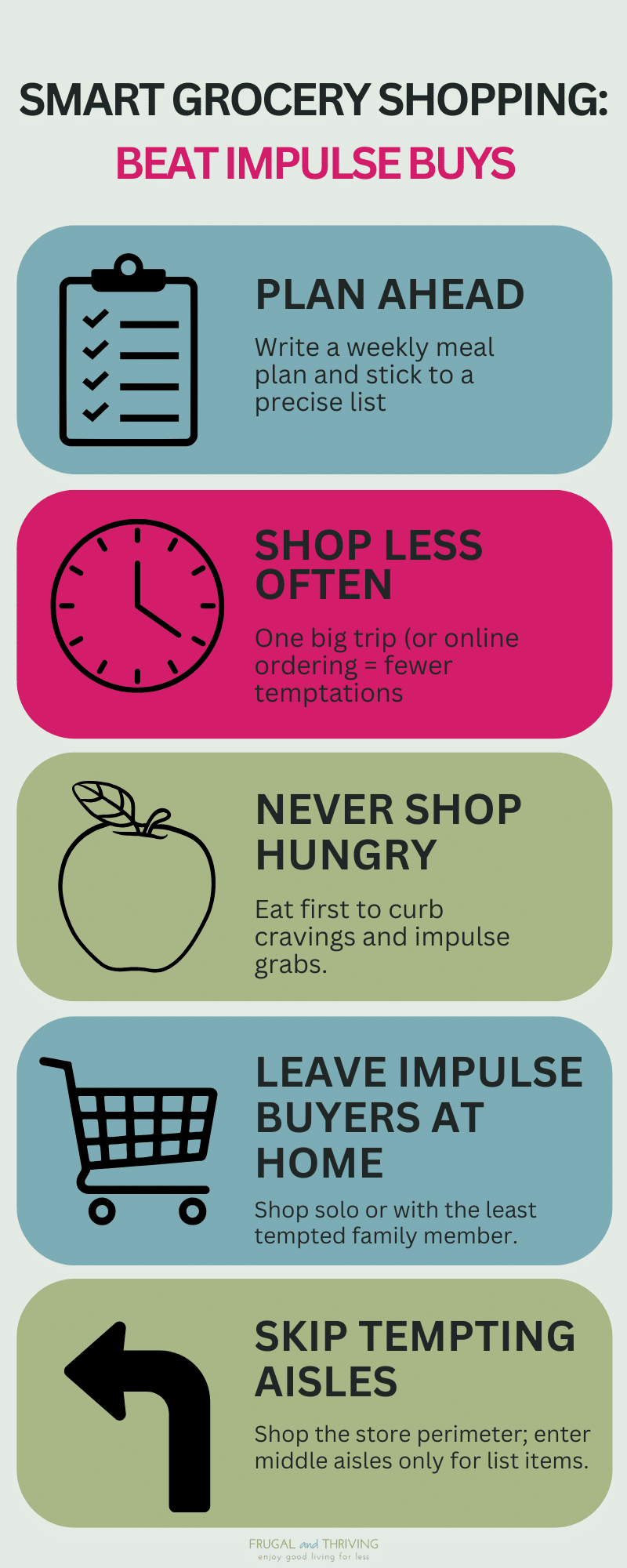
1. Plan Ahead
I have a friend who wings meal time every day. Every meal is awesome, and she never wastes anything. BUT, she’s a trained cordon bleu chef.
For me, and I think many of us, planning ahead is easier. If I only buy exactly what I need, there’s no waste. But if I buy a whole kilo of zucchini on sale? Well, I could freeze it, or make zucchini bread.
But if the week is busy and time gets away from me? Yeah, it goes to waste.
So I write a meal plan out each week, and a shopping list, and with the exception of non-perishable half-price specials that we would normally buy anyway, I stick to the list.
2. Shop Less Often
The less often you go to the supermarket, the fewer opportunities you have to be tempted. You can’t want what you don’t see.
(Well, you can, I often crave chocolate, but I can’t have it if it’s not in the house.)
We do our grocery shopping online, and that means even fewer opportunities to impulse buy. I find it much easier to stick to my budget if I shop online, and it saves me a ton of time and money.
There are pros and cons to shopping online, so an alternative is to go to the store at quiet times and when there’s no tasting displays and no delicious smells of cooking bread and BBQ chooks. Evenings can sometimes be when there are good markdowns.
3. Avoid Going to the Store Hungry
While the original paper that argued that going to the store hungry leads people to buy more was retracted in 2018 due to unreliable data, fresh studies do show that shopping while hungry can make you spend more (even on non-food items) [source], and making decisions on an empty stomach can lead to poorer outcomes [source].
So it still stands, you’re less likely to impulse buy if you’re not hungry when you shop. Depending on the timing of your shopping trip, it might help to carry a snack to tide you over.
For me, I’m a hella lot more likely to buy chocolate and other high-cal foods if I shop while I’m hungry.
On the other hand, just last weekend, we had a celebratory dinner that involved a gut-filling amount of Korean spicy-fried chicken. Then we went to Woollies to get dessert, and I’m standing there saying, “I don’t want anything, let’s just go home.” I was full, and even the thought of buying more food made my stomach turn.
4. Leave the Impulse Buyers at Home
Kids have pester power, which is one of the reasons there is chocolate and other fun stuff at their eye level in checkouts.
It’s not always possible to shop without kids (and eventually, they need to learn they can’t just have whatever), but sticking to your list can be easier without them.
An alternative is to give them a snack or a fun job (like crossing off the list for young kids or looking for the cheapest brand for older kids) while shopping so they are engaged, and less likely to be tempted out of boredom.
When it comes to who is worse at impulse buying, it can be a mixed bag depending on what you’re shopping for, gender, age, mood, external stimuli, and circumstances [source].
For instance, studies find men are likelier to wing it on gadgets or gaming gear, while women’s impulse buys lean toward cosmetics or small home items [source]. Because women still shoulder most grocery runs in Australia, they simply get more chances to toss something extra in the trolley [source].
The takeaway? If you’re looking to save money, send the person in your household who is least likely to come home with chips, chocolate, and all the extra splurges that aren’t on the shopping list.
5. Limit Which Aisles You Visit
Another way to reduce impulse buying is to limit the number of aisles you go down.
Not only does this save you time, but if you’re not wandering down the chocolate aisle, you’re less likely to be tempted to buy chocolate (unless they get you at the checkout – no judgement, they get me plenty of times.).
Research backs this up. A field study that tracked shoppers with RFID tags found that adding just 10 % to the distance you walk in-store boosts unplanned spending by about 16 %—roughly $3–$5 on a standard basket. Follow-up work shows the number of aisles entered is one of the strongest predictors of whether an extra, unplanned item lands in the trolley [source, source].
So, it can help to hug the store perimeter (produce, meat, dairy), duck into the middle only for specific list items, and you’ll dodge a lot of those “oh-that-looks-good” grabs.
There are lots of action steps you can take to save money on groceries, like comparing unit prices and meal planning, but avoiding impulse buys is a biggie.
These five tips can help.
What’s your strategy for avoiding impulse buys at the supermarket?
You might also like: Meal Box Delivery Review – Four Boxes Compared.



Hi Melissa,
I just read a great tip from a savings site (Simple Savings) I belong to about food waste. They have created a “penalty tin” and put in the amount of money they wasted on an item that was binned from their grocery budget. I am going to try the same idea, as I don’t often waste anything, but may be surprised just what amount of money I DO waste by trying this hint out!
Kaye
Hi Kaye, I read that too – it’s a great tip! Would love to hear how you go with it.
The “don’t go to the store hungry” tip is SOOOOO true. Lately l have been going after eating and l don’t end up buying the biscuits and lollies l normally would have. Then later in the day l think to myself l should have got this and this to snack on. By then you can’t be bothered going back.
If I shop hungry, I always walk out with a bag of potato chips. I admit though, if I *really* want something later, DH doesn’t need his arm to be twisted to get icecream from the servo. It would probably be cheaper to just get treats at the supermarket (although we don’t do servo runs often, maybe we’d eat more if I bought stuff all the time).
Melissa, after living in Melbourne all my life (until last year) you could just pop down the supermarket at 7 or 8pm for snacks etc. I’m in the sticks now and both little supermarkets close at 6pm. Probably a blessing in disguise. Hopefully l will lose some weight that way…:)
Yes, I could certainly benefit from some *non-convenience*.